
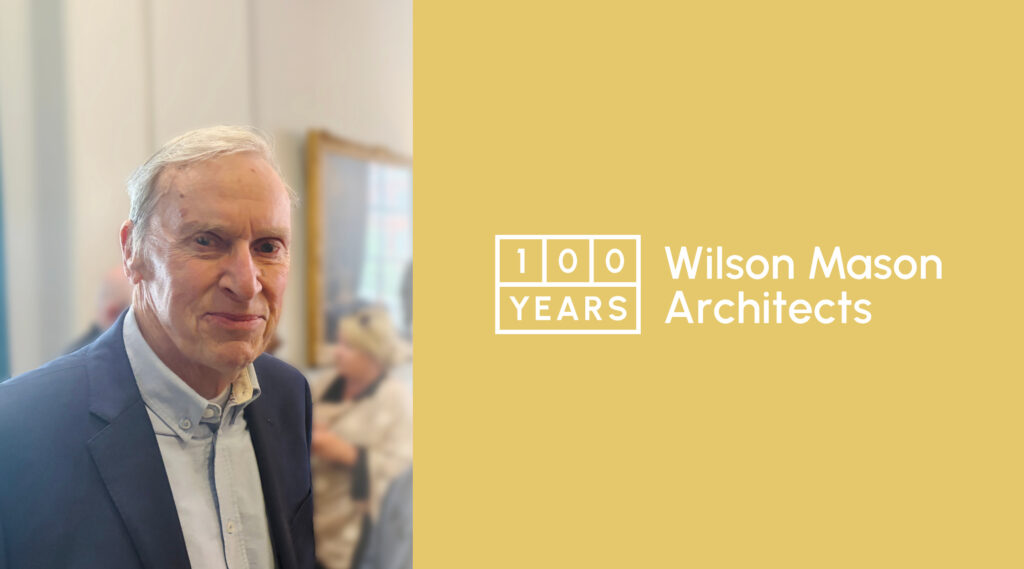
As Wilson Mason marks its centenary, we’re speaking to the people who have helped shape the practice, and those who are taking it forward.
Retired Partner, Bruce Aitken, joined Wilson Mason in 1973 as a Management Grade Architect, becoming a salaried partner in 1976 and an equity partner in 1980. He later became Senior Partner before retiring in 2007, although he continued working as a consultant until completion of the John Lewis Oxford Street Beacon project in 2008.
Here, Bruce reflects on more than three decades with Wilson Mason, the people and projects that shaped his career, changes in architectural practice and the qualities he believes have endured across the generations.
What is your earliest memory of joining Wilson Mason?
Being allotted a seat and drawing board on the first floor, where the majority of occupants were working on Middle East projects, notably Das Island. The partner in charge was Duncan Mitchell and he had a hard time managing this disparate group of mainly architectural technicians, the culture being as described in the next question.
Who were the colleagues, mentors or characters from the office who made the biggest impression on you?
The senior partner in 1976, Bill Smail, was a great mentor to me as a young practice partner, a wonderful raconteur, tremendous at bringing in work and with many clients as genuine friends, notwithstanding business relationships.
Of all the projects you worked on, which has stayed with you most?
Project Beacon at John Lewis Oxford Street, comprising substantial structural work on lightwells for installation of escalators, as well as a makeover on most levels and complete M&E services upgrade, with the on-site programme running for two years – with 365 days per year and 24-hour working – finally being completed in 2008.
Is there a client relationship from your time at Wilson Mason that you remember particularly fondly?
My first real client relationship was with Ian Myers of Barclays Bank International. Ian was the Premises Manager and I worked with him on numerous bank projects, both in the City and outside London. Again, a work hard, play hard philosophy, with occasional visits to local City hostelries to celebrate our many successes.
What do you think is the biggest difference between practising architecture then and now?
I suspect the biggest difference will be in the technology and the development of computer equipment and the ability to portray schemes in 3D at early sketch stage, and using that design information to demonstrate one’s thoughts to the client and consultants alike.
Looking back, what are you proudest of from your time with the practice?
Primarily, the successful completion of so many projects for major clients like the Bank of England, Barclays Bank International, BP and the John Lewis Partnership. Also the growth in work for retail clients from 1997 onwards, including John Lewis Partnership, Selfridges, Bhs, Harrods and Simpsons of Piccadilly, amongst others.
Despite all the changes in the profession, what do you think has remained constant at Wilson Mason?
Design development ability, working with the consultant team and liaising closely with the client.
What do you think has been Wilson Mason’s greatest legacy?
The ability to work meaningfully alongside a client and consultant team. Being honest as to what can be realistically developed and, at the end of the day, the production of well-planned and efficient buildings that the client can enjoy from day one.
Finally, how would you sum up your time with Wilson Mason?
All in all, a great practice!