
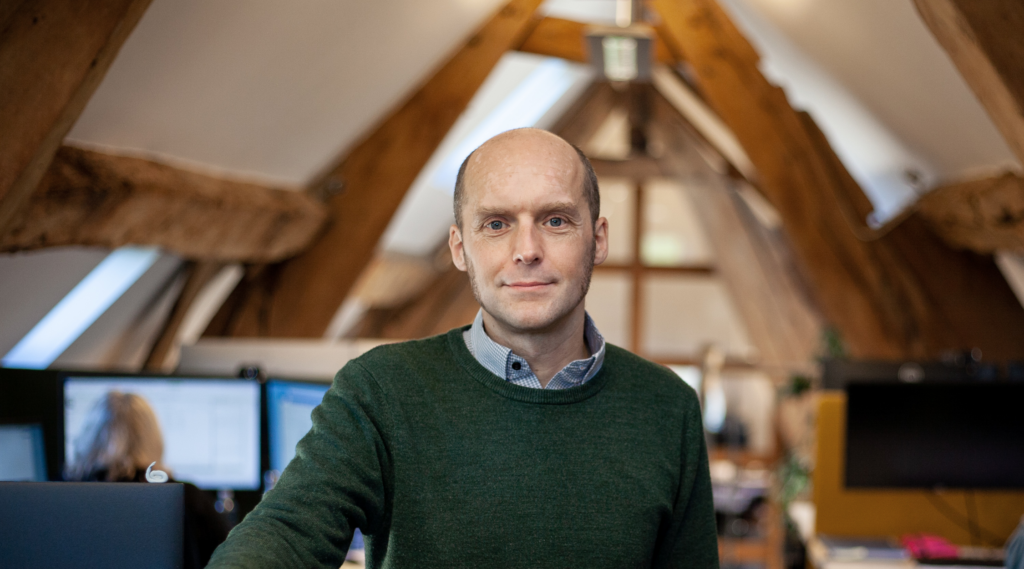
As Wilson Mason marks its centenary, we’re speaking to the people who have helped shape the practice, and those who are taking it forward.
James Potter joined Wilson Mason as an architect in 2005, becoming an Associate in 2012 and a Partner in 2014. Having spent more than 20 years with the practice, he reflects on the culture that has sustained Wilson Mason for a century, the projects and people that have influenced him, and what he hopes the next generation will inherit.
What does reaching the practice’s centenary mean to you personally?
I’m immensely proud to have been part of one fifth of Wilson Mason’s 100-year history. Twenty years feels like a significant period in its own right, but reaching this milestone also gives you a real sense of being part of something much bigger.
There is a strong sense of the baton being passed between generations. Typically we have three generations working alongside each other at any one time. I’m proud of what those before us achieved, proud to be one of the custodians at this particular moment, and genuinely excited to see where the practice goes over its next 100 years.
What do you think has enabled Wilson Mason to endure for 100 years?
I think it is an enduring culture of curiosity and collaboration. When presented with a project or problem, our instinct is to deconstruct it and understand it thoroughly – the client’s processes, the people, the structure, the services and everything needed to make it work – before putting it back together as a piece of architecture.
We constantly challenge ourselves and each other to get the very best from every commission. That enthusiasm is infectious, but importantly it is supported by robust ways of working that are continually refined and passed between generations. We are a continuous team, rather than a collection of individuals doing their own thing.
Is there any advice from previous generations of Wilson Mason that has stayed with you?
Derek Southworth was the source of many. When we were competing for work against much larger corporate practices, with all their apparent resources and capabilities, he would remind us: ‘They don’t have magic dust.’ It was a simple way of saying that they were just people, like us, and there was no reason we couldn’t compete with – and beat – them regularly.
Another was: ‘Just don’t look down.’ Keep pushing forward, take on bigger challenges and don’t retreat into your comfort zone. Both have stayed with me: have confidence in your ability, keep challenging yourself, and take enormous pride when that ambition pays off.
Of all the projects you’ve worked on, is there one that has stayed with you particularly strongly?
Booths at Hesketh Bank has always stayed with me. It was only my fourth or fifth project at Wilson Mason and became something of a coming-of-age project. Initially working under others, I was given increasing latitude to develop a new, more viable design and ultimately the trust to lead the project, client and contractor relationships through to completion.
It was a technically ambitious, award-winning building, but my strongest memories are more personal: the friendships forged through long days on site, seeing my one-year-old son playing in the café after it opened, and beginning to realise just how much more I could achieve as an architect with Wilson Mason.
How do you honour Wilson Mason’s heritage while continuing to move the practice forward?
Design excellence and technical acumen, executed to the highest standard, are the constants. Almost everything else has to keep advancing if we are to help our clients remain at the forefront of their own fields.
For me, honouring the practice’s heritage is about carrying those standards forward rather than preserving how things have always been done. During my time, Wilson Mason has continually adapted, embracing new technologies and new ways of working.
What aspects of Wilson Mason’s culture have remained constant during your time here?
The open and collaborative way we work. Every idea is worth hearing; everyone’s input is welcomed, regardless of role or experience, and people are encouraged to take ownership and really get a grip of their projects.
There is also a genuine respect for one another that extends across the practice and between generations. We work hard, challenge and support each other, and share a real enthusiasm for making the most of the exceptional projects we deliver.
What do clients need from architects today that they perhaps didn’t need 20 or 30 years ago?
Clients today need their architect to provide a clear route through an increasingly complex world. They need a safe pair of hands who can understand their particular problem, navigate changing legislation, technology and specialist requirements, and bring all of those strands together into a clear and deliverable solution.
What hasn’t changed is what should emerge from that process. Clients still need architects with the ambition to create something beyond the purely functional – architecture that is beautifully considered, enhances people’s lives and uplifts the spirit.
Which projects or client relationships have had the biggest influence on the practice?
The biggest influence has been working consistently with clients at the forefront of their own fields.
From our historic work in technically demanding industries to the Manchester Cancer Research Centre, Pirbright and the advanced science, manufacturing and energy projects we deliver today, that thread has remained remarkably consistent.
Working with people doing pioneering things is infectious. Their ambition drives ours, and has helped shape the specialist architecture Wilson Mason has produced throughout its history.
Looking ahead, what kind of Wilson Mason do you hope the next generation inherits?
I hope the next generation inherits a practice recognised for exceptional architecture, technical excellence and the quality of its people. A practice with a strong culture, an excellent reputation and clients who trust us with important and challenging projects.
I hope they have the same opportunities we have had – to work with great people, tackle genuinely interesting problems and enjoy doing it – while having the confidence to keep moving the practice forward in their own way.
When you think about Wilson Mason’s first 100 years, what do you see as its greatest legacy?
The architecture is the visible legacy. 100 years of buildings supporting people and organisations doing remarkable things. But the greater legacy is the practice behind them: the knowledge, culture and ambition passed from one generation to the next, enabling us to keep doing it.
Finally, after more than 20 years at Wilson Mason, how do you feel about what comes next?
Twenty years in, I’m still enjoying it, still learning and still ambitious about what we can do next. Being here for Wilson Mason’s 100th year is a real privilege. Here’s to the next 100!