
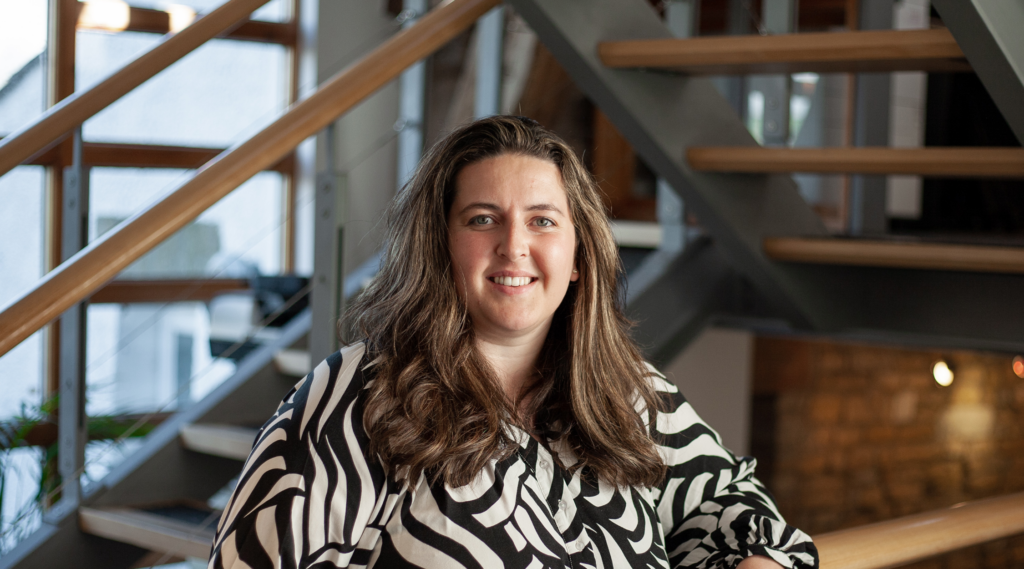
As Wilson Mason marks its centenary, we’re speaking to the people who have helped shape the practice, and those who are taking it forward.
Emma Spencer first joined Wilson Mason in 2021 as a Year Out Architectural Assistant following completion of her undergraduate degree. After returning during the summer of her master’s studies, she rejoined the practice full-time in 2024 as a Part 2 Architectural Assistant.
With the support of Wilson Mason, Emma has since completed the RIBA Part 3 qualification and is now a registered architect.
Over that time, her role has evolved from supporting wider project teams to leading projects, with experience across a diverse portfolio of commercial developments and a particular focus on new-build and refurbishment projects within the education sector.
What first attracted you to architecture?
My decision to pursue a career in architecture developed during my high school years. Fine Art at both GCSE and A Level played a significant role in shaping this interest, allowing me to explore architectural form through the study of buildings, design principles and spatial composition. This developed my understanding of the relationship between form and function.
As my appreciation of architecture grew, I became increasingly interested in its wider impact on communities and the built environment. The opportunity to combine creative design with the ability to make a positive and lasting impact ultimately inspired me to pursue architecture as a profession.
What does it mean to you to work for a practice with 100 years of history?
It is something I take great pride in. It reflects a legacy of delivering high-quality projects and building long-standing relationships with clients and communities.
It also provides the opportunity to learn from the experience, knowledge and values that have been developed over generations, while contributing to the next chapter of the practice’s history.
What have you learned from working alongside more experienced architects and colleagues?
Working alongside such an experienced team has been invaluable to my development. Their knowledge, support and mentorship have helped me gain a deeper understanding of project delivery, technical design, client engagement and the practical challenges of construction.
Through observing their approach to problem-solving and decision-making, I have developed greater confidence in my own abilities and a more rounded perspective as an architect.
Is there a piece of advice from a senior colleague that has stayed with you?
One piece of advice that has always stuck with me is that you never stop learning. The construction industry is constantly evolving and, as architects, we need to continuously adapt to new technologies, products and legislation. Throughout my career so far, I have found that every project provides an opportunity to learn something new.
Which Wilson Mason projects have helped you understand the character of the practice?
Learning about schemes such as the Manchester Cancer Research Centre and various specialist laboratory developments has given me a real appreciation for the practice’s technical expertise and collaborative approach.
Wilson Mason’s ability to work closely with clients and end users to understand complex scientific requirements and translate them into practical design solutions always stands out to me.
These projects demonstrate how the practice combines technical excellence with a proactive and client-focused approach to deliver buildings that support innovation, research and scientific advancement.
What skills have you had to develop fastest since joining the profession?
My technical skills. While architectural education often focuses on design and creativity, working in practice has given me a much greater understanding of how buildings are constructed and how designs are translated into deliverable projects.
Developing this knowledge has been fundamental to my growth as an architect and has increased my confidence in technical design, detailing and project coordination.
What kind of projects do you hope to be working on in 10 or 20 years?
I hope to be leading projects that have a positive impact on communities and the wider built environment. I am particularly interested in heritage and adaptive reuse schemes, as well as socially focused projects within the education and public sectors.
As my career develops, I would like to take on greater project leadership responsibilities and help deliver sustainable, inclusive and well-designed architecture from concept through to completion.
How important are sustainability, social value and community impact in the kind of work you want to do?
They are central to the type of projects I would like to work on. This is one of the reasons I am particularly interested in heritage and adaptive reuse projects, as they can preserve existing buildings while reducing environmental impact.
I am also drawn to education and public sector projects, where good design can make a meaningful and lasting difference to the people and communities they serve.
When Wilson Mason reaches 125 years, what do you hope people will say about this chapter of the practice?
I hope people will look back on this period as one where the practice continued to evolve while staying true to the values that have made it successful for over a century.
Having been supported through my journey from Year Out Assistant to architect, I have seen first-hand the importance of investing in people and developing talent.
On a personal level, I would be proud to know that I had contributed to that legacy through the delivery of high-quality projects and helped shape the next chapter of the practice’s history.
What do you think has been Wilson Mason’s greatest legacy?
I think Wilson Mason’s greatest legacy is its ability to remain relevant and successful over 100 years while building a strong reputation for quality, technical expertise and trusted client relationships.
From my own experience, its commitment to developing people and supporting professional growth is also a key part of what makes the practice successful.