
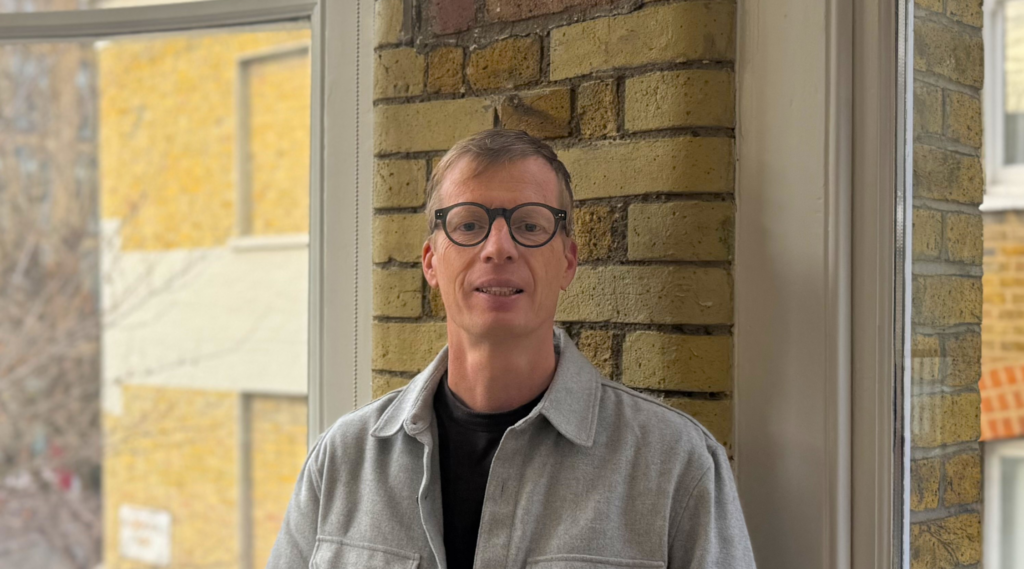
As Wilson Mason marks its centenary, we’re speaking to the people who have helped shape the practice, and those who are taking it forward.
Darren Crossley first joined Wilson Mason in November 1996 as a Part 1 Architectural Assistant. He completed RIBA Part 2 through office-based study and achieved Part 3 in 2003. In 2009, Darren became an Associate in the London office and subsequently a Partner of the practice in 2015.
Here, Darren reflects on almost 30 years with the practice, the projects and people that have shaped his career, and the qualities he believes have enabled Wilson Mason to remain relevant for a century.
What does reaching the practice’s centenary mean to you personally?
I feel proud to be part of an organisation that has not only survived for a century but continues to evolve and remain relevant. Reaching 100 years is a rare achievement and it is meaningful to contribute to a practice with such depth of history behind it.
What do you think has enabled Wilson Mason to endure for 100 years?
I think the practice has endured because of its strong reputation, the continuity of its client relationships and its ability to retain good people. Those qualities create trust, stability and consistency, which are essential over such a long period.
Is there any advice from previous generations of Wilson Mason that has stayed with you?
The professionalism of the four partners I worked with has always stayed with me. I learned the importance of combining fairness with firmness when managing a team, remaining calm under pressure and making sure a project is completed to the client’s satisfaction, whatever the circumstances.
Of all the projects you’ve worked on, is there one that has stayed with you particularly strongly?
Granta Park in Cambridge has stayed with me because it was the first project where I was given real freedom and trusted as an architect to manage packages and make design decisions, including choosing cladding colours!
How do you honour Wilson Mason’s heritage while continuing to move the practice forward?
It is definitely a balance, but I think both aspects are vital and can complement each other. We are very proud of our heritage, which often provides an interesting talking point with clients and consultants. At the same time, the practice has continued to evolve, while maintaining a clear thread of continuity in areas such as the research laboratory sector.
We are very committed to sustainable solutions, particularly building reuse rather than demolition and rebuilding. We also strive to make the best use of new technologies in drawing production and visualisation, including the latest 3D software and rendering packages, supported by staff training to ensure they are used efficiently.
What aspects of Wilson Mason’s culture have remained constant during your time here?
The leadership has always had a genuine interest in technically challenging projects. As a result, our dedicated teams can take the positive lessons learned from complex schemes and apply them to future projects, providing added value for clients from the outset.
We have also been able to maintain low staff turnover, helping us retain and strengthen the project knowledge acquired over time. In addition, we have been very fortunate to continue long-standing relationships with some fantastic clients.
What do clients need from architects today that they perhaps didn’t need 20 or 30 years ago?
Flexibility is increasingly important. With project budgets becoming ever tighter, inevitable changes need to be incorporated intelligently to avoid programme implications. This is particularly true in the public sector, where we often need to respond as new funding becomes available. Our teams are adept at explaining the implications to clients and producing updated information swiftly.
Which projects or client relationships have had the biggest influence on the practice?
The Middle East oil industry at the start of the twentieth century provided the foundations on which the practice was built. The scale of those projects, and the masterplanning involved, helped develop a broad range of skills and experience that was ultimately transferred into other sectors and environments.
Work with BP and Glaxo was a natural evolution of these early roots and helped establish the practice in the UK pharmaceutical laboratory sector.
John Lewis & Partners, together with work for Bhs and Harrods, formed a strong retail division within the practice, originating in the 1990s and continuing well into the 21st century.
In recent years, the practice has delivered schemes for a number of universities, including King’s College London, University College London, London School of Economics, Imperial College London, Lancaster University and University of Manchester.
This has continued the research laboratory thread and extended naturally into healthcare, with projects such as the Manchester Cancer Research Centre and extensive fire compliance works at Newham Hospital.
Looking ahead, what kind of Wilson Mason do you hope the next generation inherits?
I hope the next generation inherits an agile practice: one capable of delivering the same quality on small refurbishments as on large, complex projects. I would like it to remain sustainable, both in its own operations and in the designs it produces for clients, while continuing to build and sustain long-standing relationships with trusted clients.
What do you think has been Wilson Mason’s greatest legacy?
Wilson Mason has left a lasting legacy in the Middle East, where many public buildings, including railway stations, still stand today. These projects helped inspire local architects and contributed to the organic evolution of cities, building on the firm foundations established by J.M. Wilson. We have also remained at the forefront of scientific and healthcare research, striving to make a positive impact on both human health and the built environment.
Finally, after almost 30 years with Wilson Mason, how do you reflect on its history?
It has been both a pleasure and a thoroughly enjoyable experience to delve into the practice’s rich history over the last 100 years.
Even after being part of Wilson Mason for the past thirty years, it still feels like a voyage of discovery, and a very rewarding one.