
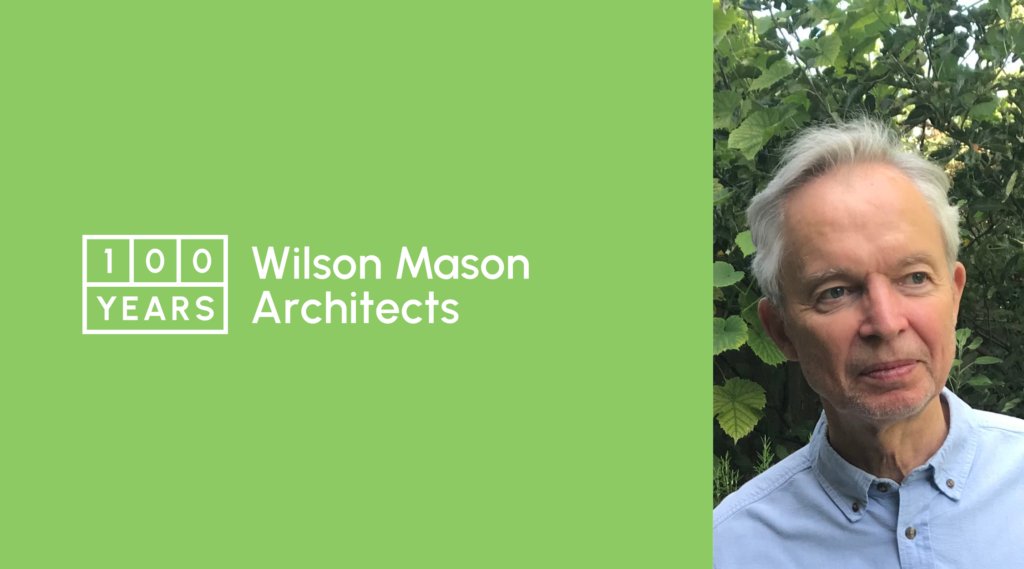
Peter Etches joined Wilson Mason in 1978, became an equity partner in 1988 and was appointed Senior Partner in 2007. His career took him from London to the Middle East, working on projects ranging from commercial developments to complex scientific research facilities.
Here, Peter reflects on the culture of the practice, the evolution of architecture and the relationships and projects that have stayed with him.
Can you tell us about your journey at Wilson Mason?
I joined Wilson Mason in 1978 as a qualified project architect, having spent the previous seven years gaining experience with four architectural practices in central London.
In 1980, the then Senior Partner, Bill Smail, offered me the opportunity to become Resident Engineer on Das Island in the UAE, heading a small team responsible for a programme of new buildings and refurbishment works. This included a medical centre, mosque, offices, retail facilities and accommodation.
I returned to London in 1983-84 and became an Associate shortly afterwards. During a period supporting the practice’s Hertford office, I secured a new client, BHS, which led to several years of commissions for new stores in locations including London, Worcester and Portsmouth.
Having also qualified as a landscape architect, I was able to help the practice secure landscape architecture commissions in the UK and Middle East.
I became an equity partner in 1988, alongside Robert Ward, and Senior Partner on 1 May 2007, following Bruce Aitken’s retirement.
I retired from the partnership in 2013 but continued as a part-time consultant, working on projects including a substantial laboratory development for Public Health England.
What is your earliest memory of joining the practice?
I remember being interviewed in the ground-floor conference room at 3 Chandos Street by Jim Peters, one of the partners.
Jim considered me a suitable candidate and sent me upstairs to meet Bill Smail, the Senior Partner, for further discussion.
One of my conditions for joining was that I could take half a day’s leave every Tuesday to complete a four-year, part-time course in landscape architecture, which I had started two years earlier.
Bill agreed, and I was appointed Project Architect on a new workshop and office development for Glaxo Operations at Ware in Hertfordshire.
It was a positive start to what became a long and rewarding career with the practice.
What was the studio culture like when you first joined?
One thing I particularly liked was the office hours – 9.30am to 6pm! I was based in a small, two-person room on the third floor of 3 Chandos Street. For the first few months, I was its sole occupant, so I was somewhat isolated from the larger drawing office across the landing.
Like many architectural practices of the time, the office occupied a Georgian or Regency townhouse, with a central staircase and individual rooms on each floor. The rooms generally became smaller as you went upstairs.
This encouraged people to work in small groups, often on the same project, and helped create a relaxed and friendly atmosphere.
Everyone worked hard and shared their knowledge. I felt at home from my first day and throughout my time there.
Of course, drawing boards and T-squares were the order of the day. There were no PCs, and every architect needed sufficient space for a large drawing board, equipment and layouts.
Looking back, there was something of a craft-like experience about architectural practice in those days.
Which colleagues or mentors made the biggest impression on you?
There were so many people, both in London and the Middle East, who made a lasting impression on me for different reasons.
Over the years, I worked alongside some excellent colleagues and built relationships that I remember fondly.
I couldn’t possibly do them all justice in a short interview.
Which projects from your time at Wilson Mason have stayed with you most?
I’ve loved all the projects I’ve worked on at Wilson Mason, particularly those where I’ve been part of the team that secured the commission in the first place.
Some of the most exciting were the large-scale masterplanning projects for scientific research sites, where we were involved from inception through to completion.
These projects combined site planning and landscape design with the detailed design of complex laboratories and associated facilities.
Examples include projects for Shell Research, CAT at Granta Park, the redevelopment of Porton Down, the Veterinary Laboratories Agency at Weybridge and the Pirbright laboratories.
What made these projects particularly rewarding was the opportunity to bring together site planning, landscape architecture and the detailed design of highly complex buildings.
Is there a client relationship you remember particularly fondly?
Alan Mitchell at University College London is someone I remember particularly fondly.
What do you see as the biggest changes in architecture since you started?
One of the most positive changes has been the growing number of excellent female architects entering the profession.
Architecture has also become much more competitive, particularly in relation to fees and the influence of larger international practices.
The technical demands of the profession have changed considerably too. Sustainability, legislation and the specialist knowledge required for different building types have all become increasingly important.
And, of course, there’s the growing influence of technology and potentially artificial intelligence.
When I started, we were working with drawing boards and T-squares. The profession today is very different in the way projects are designed, developed and delivered.
What are you proudest of from your time at Wilson Mason?
I’m particularly proud of helping to continue and expand the practice’s work into increasingly complex building types.
The development of our expertise in new and refurbished scientific research facilities, including high-containment laboratories, was particularly rewarding.
These projects helped strengthen Wilson Mason’s reputation for delivering complex, highly specialised research facilities.
What do you think has remained constant at Wilson Mason, and what is its greatest legacy?
For me, it’s the continuity of the practice and the qualities that have been maintained through successive generations of partners.
Trust, confidence and professionalism have always been central to Wilson Mason’s relationships with clients and to the way the practice approaches its work.
The stewardship of the current partners continues that tradition.
Those qualities have benefited clients over many decades and contributed to the impressive range of projects the practice has successfully completed since 1926.