
As Wilson Mason marks its centenary, we’re speaking to the people who have helped shape the practice, and those who are taking it forward.
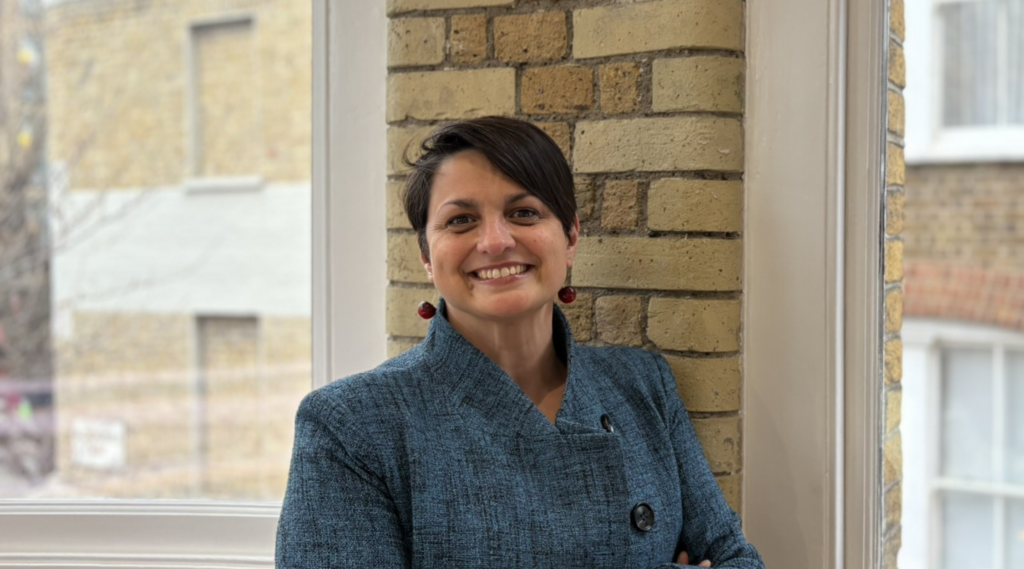
Dominique Haslam first joined Wilson Mason in 1996, returning to the practice in 2004 and becoming a partner in 2016. Her career has spanned a wide range of projects, including technically demanding buildings for science and research.
Here, she reflects on the people and advice that shaped her career, memorable projects and the qualities that have helped Wilson Mason endure for a century.
Can you tell us about your journey at Wilson Mason?
I first joined Wilson Mason in September 1996, after completing my undergraduate degree in architecture. I spent 1996–97 as a Part I architectural assistant, working across the interiors department, TMA Wilson Mason and other parts of the practice on all floors of Chandos Street.
It was in the basement tea point that I first met Darren Crossley, now a fellow partner. We then spent most Friday nights in the local watering hole with a group of junior colleagues.
I worked one day a week while studying for Part II, returning full-time in 1999. With support from colleagues, I qualified as an architect in May 2001. The following day, I chaired my first Stage 5 kick-off meeting with a contractor on a laboratory extension project for the University of Southampton.
After several years as a project architect, I moved to another firm to satisfy a little FOMO and check I wasn’t getting too comfortable. The grass wasn’t greener. I returned in 2004, progressed to associate and became a partner in 2016.
What does Wilson Mason reaching 100 years mean to you personally?
I’m thrilled. It’s a big feat by anyone’s standards. Having been here for the 75th celebrations and worked alongside former partners with encyclopaedic knowledge of our history makes it all the more special.
What do you think has allowed the practice to endure for a century?
Our ability to evolve, taking the best of our past while continuing to move forward. Just as importantly, we have an open and supportive team that helps people reach their potential.
What advice from your predecessors has remained with you and why?
Lists, lists and lists! As a newly qualified architect, I felt swamped by a live project and a contractor keen on sending RFIs. Lists helped me organise my work and thoughts and gave me a response when partners wandered past with something else to add!
I’m still known at home as ‘list girl’, a case of work habits crossing into personal life – for the better!
When several workstreams are running, finishing one thing rather than having everything almost finished is a real morale boost.
That advice came from former partner Rob Ward. You shouldn’t have favourites, but Rob was my preferred partner to work with. He was clear about what he needed, listened when you made a reasoned case, and backed you to the hilt when necessary. There was no micromanaging: he gave me agency, with a safety net when I needed one.
What project from your time at the practice has stayed with you most, and why?
The European Space Agency’s new conference centre.
I was involved from the outset, at a time when former partner Steve Cox was approaching retirement and introducing a new partner to an established client.
I began sketches in 2016. The project went through feasibility studies, costing and budget reductions. Just as it was moving from Stage 2 to Stage 3, Covid and lockdown arrived.
Looking back, it’s hard to remember how disjointed working life felt then.
In May 2020, I drove from London to a field near Didcot to review levels and discuss issues we couldn’t resolve remotely. ESA required cameras to be off, so calls felt like talking into the abyss. Shouting across a field to our client, Hilde, was a welcome break from six difficult weeks of lockdown.
Hilde had a background in science and satellite launches before moving into facilities and estates. I realised that what passes for a tolerance in construction could be unacceptable in spacecraft or satellite launches. Understanding each other’s perspectives and finding a common language reminded me of the importance of real human connection, both for the project and for ourselves, especially during such a difficult time.
Despite value engineering, we retained the space’s character and critical features, along with moments of interest and joy. I could explain every detail and decision; nothing is there by accident.
My favourite is a large window that catches the low winter sun, with a deep sill to sit on. It’s simple and human, yet connects the building to the seasons and the Earth’s relationship with the sun.
How do you balance honouring Wilson Mason’s heritage with the need to keep changing?
Wilson Mason began with strong client relationships, technical competence and vision. Our repeat business, from the early years to today, is something to be proud of.
We honour that legacy by continuing to deliver a high level of service and bring the best out of every project, even as the practice evolves. It’s part of who we are.
What values or ways of working do you think have remained constant in the practice?
Being supportive, open and honest. I couldn’t have completed my architectural qualifications without colleagues’ help, from architects to administration teams.
Every project demands that we learn something new. We have specialisms, but that willingness to keep learning and throw yourself in dates back to our founder’s early work in India and what became Iraq. The context has changed enormously, but the instinct to learn remains.
What do clients need from architects today that they perhaps did not need 20 or 30 years ago?
Technology, particularly AI, is changing the traditional responsibilities of architects. However, our professional code of conduct and the principles that guide our behaviour remain just as important.
Clients need a trusted pair of hands who will challenge information, check whether it’s accurate and spot where things aren’t as they seem. AI can produce plausible but incorrect answers, potentially leading projects down costly paths and putting professional integrity at risk.
Used carefully, AI can help with research, document reviews and even meeting minutes. But effective prompting, rigorous checking and human oversight remain essential. AI may remove some of the churn, but it makes our ability to interrogate information, provide professional oversight and act ethically more important, not less.
Which projects or client relationships have had the biggest influence on Wilson Mason?
Historically, our relationships connected to the Middle East, BP, Glaxo and other major organisations helped shape the practice. Over the past 30 years, higher education (a sector I’m heavily involved in) has become particularly important. University estates bring together many of our core areas, from science and research to healthcare teaching, offices and student facilities, across new buildings, refurbishments and extensions.
Looking ahead, what kind of practice do you hope the next generation inherits?
A forward-thinking practice equally comfortable with design-led projects and highly technical environments.
We do both now, but the growing demands of sustainability will rightly challenge us to do more. Rigorous design that meets client briefs, legislative requirements and demanding technical standards will be more relevant than ever.
What do you think has been Wilson Mason’s greatest legacy?
Fantastic architecture, enduring client relationships and the ability to deliver strong design while resolving complex technical requirements for individual clients.
That’s as true today as it ever was, and it seems to me a great legacy.