
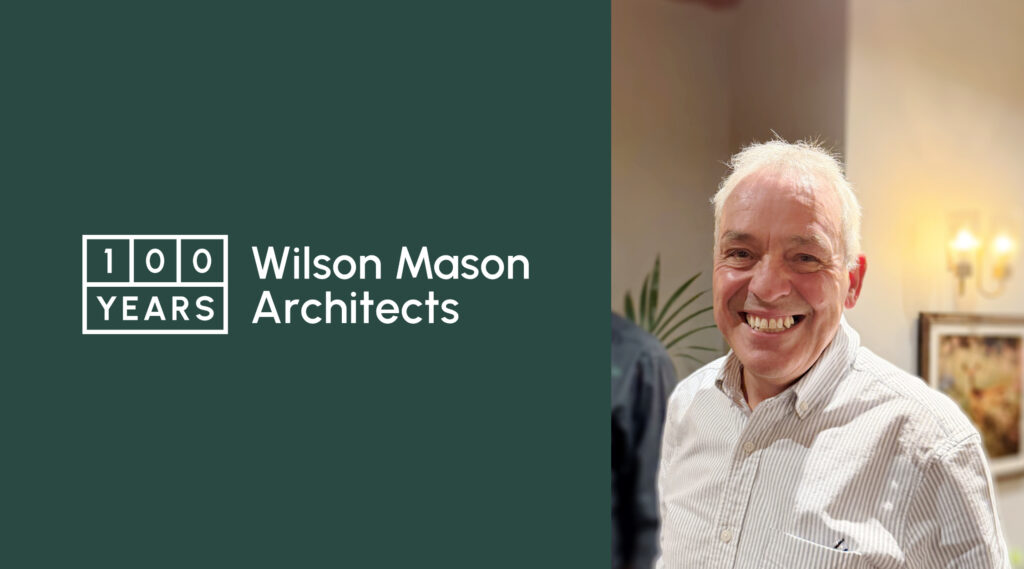
As Wilson Mason marks its centenary, we’re speaking to the people who have helped shape the practice, and those who are taking it forward.
Derek Southworth joined Wilson Mason’s Doha office in Qatar in 1985 as a junior architect and became an Associate in 1988. He returned to the UK in 1990 at the time of the Gulf War, when increasing commercial pressures in the Middle East made the Doha office commercially unviable.
On his return, Derek was asked to open an office in Preston, which went on to become Wilson Mason’s North office.
Here, Derek reflects on those pioneering early years, the people and projects that shaped his career, and the ethos he believes has enabled Wilson Mason to thrive for 100 years.
What are your earliest memories of Wilson Mason?
Having worked in a number of architectural practices in my early years, which were rather impersonal and bureaucratic, the interesting history of Wilson Mason – then a 60-year-old practice, with historic links to Lutyens and based at 3 Chandos Street in London – was very appealing.
Having joined Wilson Mason in the Middle East, my earliest memories of the practice involved trying to develop projects in a challenging commercial environment, where fees were very competitive and you were working in another country where the rules that did exist were very different to home.
Because of the cost of supporting a large office overseas, numbers were small and back-up support was limited. The London office was 3,500 miles away, with a two or three-hour time difference and limited telephone contact.
As a consequence, you became self-reliant when problem-solving, which usually involved having a chat with yourself in the corner and then getting on with it. It was a good training ground.
What was the culture like in those early years?
Because of the circumstances of my early years with the practice, there was not a great deal of office culture to experience.
When the Preston office opened in 1990, we were camped out in the conference room of cost consultants, William Clarke Partnership, at 36 Ribblesdale Place in Preston. There was just me, the Yellow Pages and a telephone cable that was not long enough to reach the desk!
London was very supportive when it could be, but once again it was more than 200 miles away, which meant we had to develop a culture of self-sufficiency.
What this did enable, however, was the creation of a lively, creative and open environment as the practice grew in the North West. It encouraged teamwork, supported younger members of the team and had a focus on play as well as work.
Which colleagues, mentors or characters made the biggest impression on you?
In my early days, Duncan Mitchell, the senior partner in the London office, was a very supportive figure during my time in the Middle East and at the beginning of the office in the North. He was a very kind man, easy to talk to and caring.
I will also always have fond memories of the early days in Preston and the amazing support given to me by Alan Kay, Jeremy Birtwell and Paul McEvoy. They had such a can-do mentality and together we overcame many challenges with limited resources. Thanks guys! Those days were quite hairy.
Is there one project from your time at Wilson Mason that has stayed with you most?
It would be very difficult for me to pick out one project that made the biggest impression.
The practice has a long track record of developing complicated buildings involving challenging sites, complex briefs and tight budgets. As a consequence, many of our completed projects have an interesting story to tell.
That could be the development of the Petrochem laboratories for Shell Research in Chester, a £23m project in 1995 which had to be designed and constructed in 18 months, or the Booths store at Barrowford, which was built over an active culvert serving 60 acres.
Each project had its challenges but was made successful by finding creative solutions to complex problems, usually by applying a divide-and-conquer approach to conflicting brief requirements.
Are there client relationships you remember particularly fondly?
Over the years there have been a number of clients who have been very supportive of the practice.
One of the first was Cliff Jones, a project manager at Shell Research in Chester, whom I met at a corporate clay pigeon shoot in Cheshire. Cliff gave us a commission to undertake a six-week ideas study alongside another practice – Fairhursts. We were subsequently successful in winning a nine-month study, which eventually led to the development of phases one and two of the masterplan in 1995-98, with a combined construction value of £41m. This was a major boost to the practice as a whole, during what was a deep recession.
Later, Mark Swindlehurst, Director of Facilities at Lancaster University, and Diane Hampson, Director of Estates, were strong clients who were both very demanding but fair. They supported innovative architecture and recognised the practice’s commitment to going above and beyond what was required. We were all on a journey to satisfy our respective clients, but it was done collaboratively and based on professionalism.
What makes a building stand the test of time?
Great architecture should be based on the sculptural quality of the building form and should not rely on the application of cosmetic surface finishes to create interest in what would otherwise be a bland design.
Buildings should look inspiring even if they were built out of cardboard. Timeless architecture is based on design quality rather than trends, using honest materials well and without clutter.
Looking back, what are you proudest of from your time with the practice?
My greatest pride is seeing how, over the years, the practice – particularly in the North – has been driven by a passion to create inspirational architecture and has successfully established its reputation as a design-led and technically competent practice. There is no point having dreams if you can’t deliver them.
It is the job of the architect to maximise the benefit a project can deliver to the client, in terms of functionality, aesthetic design and improvements to the quality of their working environment, and to go well beyond expectations.
For this approach to be successful, it cannot just be words. It has to be a driving force within the practice ethos and be shared by all members.
I think this is still the case within the practice and have no doubt it will be passed on to future custodians of the Wilson Mason legacy. We don’t do average!
What has remained constant at Wilson Mason despite all the changes in the profession?
Throughout its history, the enduring constant within the practice has been its ability to deliver a professional service to clients that is project-led and focused on maximising the benefit that can be achieved from the brief.
What do you think has been Wilson Mason’s greatest legacy?
For any architectural practice to successfully deliver a sustained level of service to its clients over 100 years, and to thrive, is an achievement few have accomplished.
It is a testament to the practice’s ability to remain focused on client delivery, innovation and design quality, while maintaining a supportive culture that encourages its people to think the unthinkable and deliver excellence.