
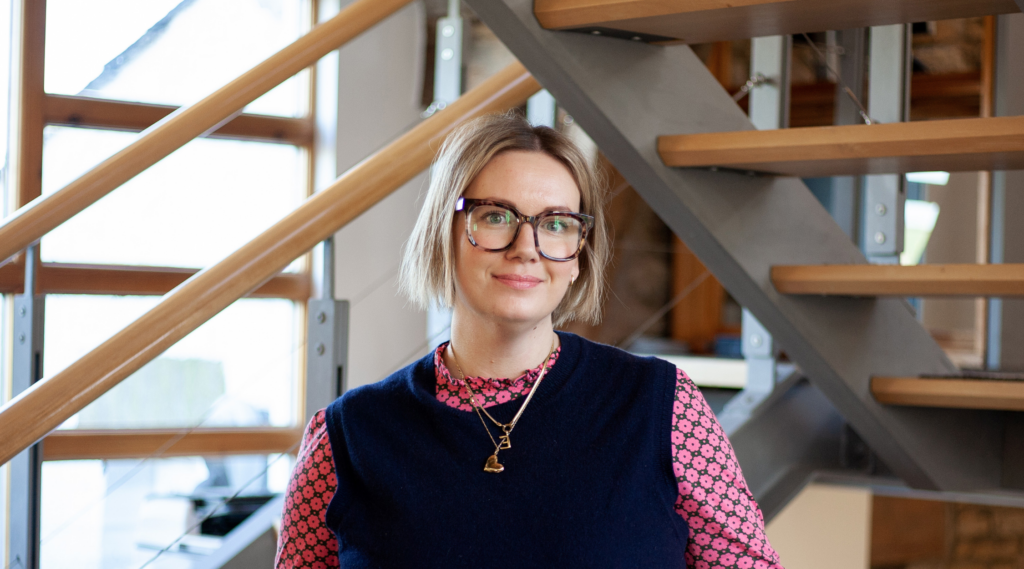
As Wilson Mason marks its centenary, we’re speaking to the people who have helped shape the practice, and those who are taking it forward.
Eleanor Wood first joined Wilson Mason in 2014 as a Part II student, returning to the practice in 2021 as a senior architect before becoming a Partner in 2024.
In the latest of our 100th anniversary Q&As, Ellie reflects on the projects and people that have shaped her career, the values that have helped Wilson Mason succeed for over a century, and the importance of embracing change while staying true to the practice’s heritage.
She also shares her thoughts on the changing role of architects and the legacy she hopes Wilson Mason will pass on to future generations.
What does reaching the practice’s centenary mean to you personally?
It’s both inspiring and humbling. The anniversary has reminded me that we are only one chapter in a much larger story. As Partners, we are temporary custodians of the practice, building on the dedication, talent and hard work of the generations that came before us.
What do you think has enabled Wilson Mason to endure for 100 years?
I think the practice has endured because it has never stood still. While quality has always been at the heart of what we do, Wilson Mason has consistently adapted to changing client needs, technologies and industry challenges. That combination of technical expertise, long-standing client relationships and a willingness to evolve has allowed the practice to remain relevant and successful across multiple generations.
What advice from your predecessors has remained with you and why?
“Is it your best work?” is something former Partner Alan Williams used to say a lot. It was always very annoying at the time, but it’s a valid question!
We should never be satisfied with ‘good enough’ and should always strive to push the boundaries and exploit every design opportunity. You don’t get that many opportunities to do that during your career.
What project from your time at the practice has stayed with you most, and why?
The Manchester Museum top-floor refurbishment remains particularly memorable for me. It was my first project at Wilson Mason and later became the case study for my RIBA Part III qualification.
Working within a Grade II* listed building alongside Ben Kelly Design presented a fascinating mix of conservation, design and technical challenges. It was also my first opportunity to take a leading role on a project. Alan Williams provided the right balance of support and trust, giving me the confidence to develop as a project architect.
Seeing the completed space being enjoyed by visitors was immensely rewarding and reinforced why I chose this profession.
More recently, the i3 Building at Liverpool Hope University was a brilliant project to work on and I’m sure, when I look back over my career, it will be one of the stand-out projects.
It’s a fantastic building, both in terms of the architectural quality of its spaces and the positive learning outcomes it facilitates.
How do you honour Wilson Mason’s heritage while continuing to move the practice forward?
The built environment is constantly evolving. While the way we work may change, the principles that underpin Wilson Mason remain consistent. Our curiosity, appetite for technical challenge and commitment to quality continue to guide our decision-making.
Those values provide a strong foundation while allowing us to embrace change where it creates better outcomes for our clients and projects.
What aspects of Wilson Mason’s culture have remained constant during your time here?
A commitment to learning and continuous improvement has always been central to the practice.
There is a genuine willingness to share knowledge, challenge assumptions and learn from both successes and setbacks. That culture of curiosity and collaboration has remained remarkably consistent throughout Wilson Mason’s history.
What do clients need from architects today that they perhaps didn’t need 20 or 30 years ago?
Clients today expect architects to do a lot more than design buildings. They need advisers who can navigate increasingly complex requirements around sustainability, building safety and digital technology.
While good design remains fundamental, clients increasingly value architects who can resolve complex problems and provide confidence throughout the delivery process.
More than anything, I think they need to feel they have a trusted pair of hands and someone they can rely on to guide them through an ever more complex process.
Which projects or client relationships have had the biggest influence on the practice?
Long-standing client relationships have undoubtedly been one of the biggest influences on the practice.
Our work within the science, research and industrial sectors, in particular, has helped shape our technical expertise and reputation. Those strong foundations have also opened doors into other sectors.
We started working in higher education through our expertise in delivering research facilities. Over time, this has developed into projects across all stages of education, including EYFS and SEND facilities. These projects are incredibly rewarding.
Looking ahead, what kind of Wilson Mason do you hope the next generation inherits?
I hope the next generation inherits a practice that is respected for both the quality of its work and the quality of its culture. I’d like the practice to retain its status of being a place where talented people can develop fulfilling careers, collaborate with great colleagues and work on projects that make a meaningful difference.
Most importantly, I hope it remains a practice that embraces challenge, continues learning and never loses its enthusiasm for architecture.
What do you think has been Wilson Mason’s greatest legacy?
It’s the collective impact of the buildings it has delivered and the activities those buildings have enabled.
Architecture is ultimately about what buildings make possible. They are not simply objects to be looked at, nor are they purely functional spaces. Great architecture enables great things, whether that’s education, research, healthcare of innovation. Developments such as the Manchester Cancer Research Centre demonstrate how buildings can create environments that facilitate important work and have benefits far beyond the project itself.