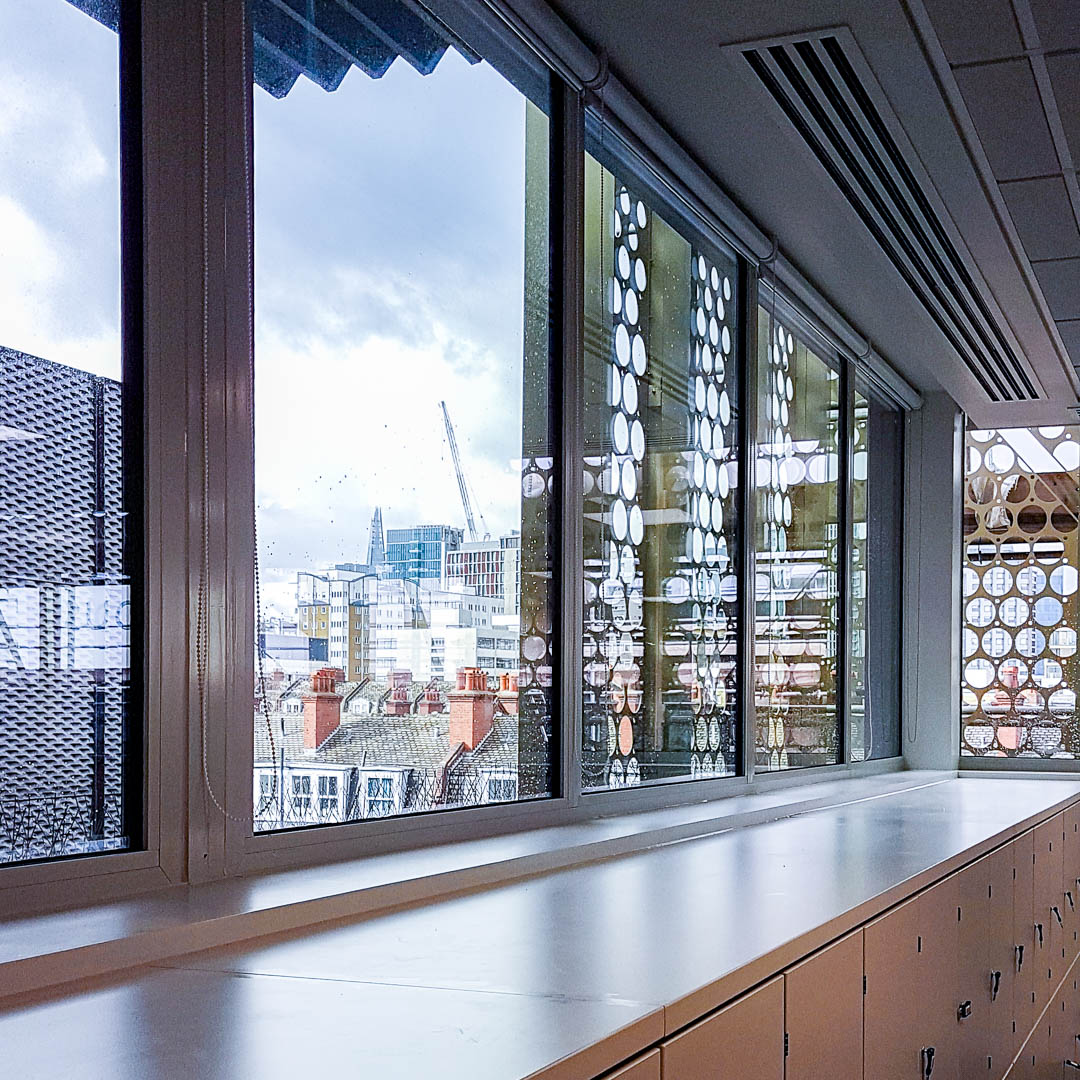
The dual brief combined the need for a visually striking façade upgrade with a technically robust improvement to building performance. The existing redbrick exterior and powder-coated framing were retained but resprayed and stained to provide a uniform dark colour background , with a perforated 5mm thick anodised alumnimum cladding in a bold colour set off the face of the original building to provide significant solar control and address the overheating issues within the building and reduce the use of cooling.
Upgrade for improved thermal performance was limited to areas that would provide the greatest payback rather than wholesale upgrade for little additional benefit.
Internally, the third floor was stripped out and refurbished to house flexible research offices, secure patient data facilities, and high-quality breakout spaces for academic and industry collaboration. The space was also adapted to host industry events and research showcases, with a newly refurbished stair and lobby supporting improved access and presence.
The building’s freehold extended beyond its footprint but had since been partially adopted as public pavement. This ruled out any ground-level cladding support. Instead, the design introduced a cantilevered façade solution fixed to the building at the first-floor slab, respecting the legal boundary while maximising solar protection.
Targeted strengthening works were introduced to support the new cladding and formed part of an early enabling phase to de-risk the later works. A major constraint was the requirement to keep ground and lower floor labs live and compliant throughout construction. The new cladding was designed to avoid any need for internal access, and window glazing replacements were tightly sequenced to align with laboratory access protocols.
Although the building performed relatively well thermally, its primary issue was excessive heat gain on the western elevation. The façade solution featured a mix of solid and perforated aluminium panels, strategically placed to optimise solar shading while retaining outward views from offices. In more public-facing areas, screening was partially removed to maximise visual connection to the city.
The new façade gave the Abernethy Building a more appropriate architectural presence within its cluster of high-profile university and research buildings. Linear lines and a subtle angle within the face of the cladding reinforces the building’s entrance and identity and aligns with the wider university street frontage.