
As Wilson Mason marks its centenary, we’re speaking to the people who have helped shape the practice, and those who are taking it forward.
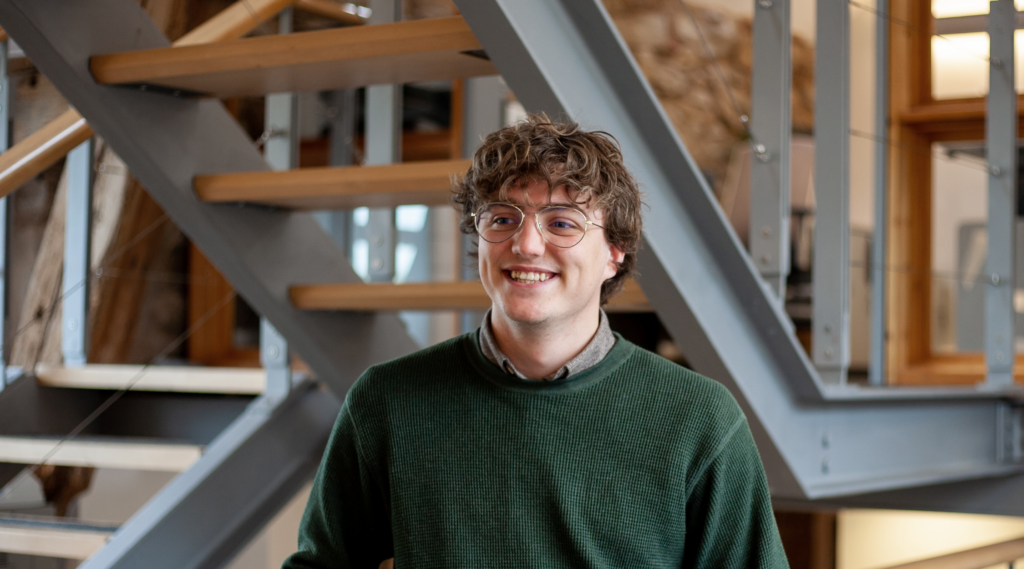
Owen Harwood joined Wilson Mason in June 2023 as a Part 1 Architectural Assistant after completing his undergraduate degree. Since then, Owen has worked across a range of commercial projects, with a particular focus on large-scale manufacturing and technical facilities.
Alongside his role, Owen is completing an architectural apprenticeship, supported by Wilson Mason, as he works towards qualifying as an architect.
Here, he reflects on starting his career at a 100-year-old practice, what he has learned so far and the kind of architect he hopes to become.
What first attracted you to architecture?
I’ve always had an interest in design and creativity. Growing up, I enjoyed building with LEGO and later developed a passion for graphic design and photography, which I studied at college.
I wanted to take those creative skills and apply them to something more tangible. Architecture appealed to me because it combines creativity with problem-solving and gives you the opportunity to shape spaces that people use and experience every day.
What does it mean to you to be starting your career at a practice with 100 years of history?
For me, it is quite significant. Having been around for 100 years shows an ability to adapt and remain relevant through generations of change in both architecture and the wider industry. As someone relatively new to the profession, it is interesting to be part of that continuing story and to learn from the experience that has been built up within the practice over many years.
What have you learned from working alongside more experienced architects and colleagues?
Coming straight from university, I was focused mainly on design. Since joining Wilson Mason, I’ve learned how important the technical side of architecture really is.
One of the biggest things I’ve realised is that good architecture isn’t just about coming up with a great design, but understanding the bigger picture, the technical requirements and how different disciplines collaborate.
Working alongside colleagues has shown me the importance of paying attention to detail and understanding the reasoning behind decisions, and what implications a change may have elsewhere.
Is there a piece of advice or lesson from a senior colleague that has stayed with you?
A lesson that has stayed with me is that you never stop learning in architecture.
Working alongside colleagues has shown me the depth of understanding required to consider the wider implications of a design, how it affects other disciplines and why decisions are made. This is something I continue to develop and understand.
Every project brings new challenges and provides an opportunity to build my own skills.
What have Wilson Mason’s projects taught you about the character of the practice?
The scale and complexity of these projects show the practice’s ability to work on technically demanding buildings where design, engineering and operational requirements all need to come together.
What has stood out to me is the collaborative approach, working closely with clients and consultants to find practical solutions while creating well-considered spaces.
What skills have you had to develop fastest since joining the profession?
I had to quickly develop my understanding and use of Revit. Throughout university, there was less emphasis on learning specific software, but in practice it became clear how important it is.
Within my first few weeks at Wilson Mason, I was brought up to speed and given the opportunity to work on a live project.
This helped me develop not only my technical ability, but also how to collaborate with colleagues, understand best practice and improve efficiency in the way we work.
What kind of projects do you hope to be working on in 10 or 20 years?
I hope to have worked across a wide range of projects that continue to challenge me creatively and technically.
My experience so far has given me a strong understanding of large-scale manufacturing and technical buildings, where problem-solving and coordination are key.
Looking ahead, I would like to broaden my experience by working on projects that allow more creative freedom, whether that’s residential, one-off homes or projects with a stronger focus on the users and their experience of a space.
How important are sustainability, social value and community impact in the kind of work you want to do?
These are fundamental parts of good architecture. Buildings have a long lifespan, so the decisions made during design can have an impact for many years beyond completion.
I want to work on projects where these considerations are integrated from the beginning, creating buildings that are not only functional and efficient, but also have a positive impact on the people who use them and the wider environment.
When Wilson Mason reaches 125 years, what do you hope people will say about this chapter of the practice?
As someone at the beginning of my career, I hope I can look back and feel that I played a small part in an exciting period of the practice’s history.
I hope this chapter is remembered for embracing change, developing new talent and continuing to take on ambitious projects, while building on the experience and reputation that the practice has developed over its first 100 years.
What do you think has been Wilson Mason’s greatest legacy?
I think it’s the knowledge, experience and relationships that have been built over 100 years. The practice has continued to evolve alongside the changing needs of the industry while maintaining a strong reputation for delivering quality projects for its clients.
Being able to pass that experience between generations of architects and continue developing new talent is something that makes the practice unique.